BLOG

7 Best Pallet Wrapping Machines for 2026

Choosing a pallet wrapping machine in 2026 is less about buying the fastest model and more about matching equipment to the work. A small warehouse wrapping a few mixed loads each hour has different needs from a distribution center running continuous shifts. Load weight, pallet dimensions, film use, floor space, and operator experience all matter. So does the kind of wrapping system: turntable machines suit many standard loads, while rotary-arm designs can help keep unstable pallets still.

This guide looks at seven options through practical criteria, including wrapping consistency, controls, rated capacity, safety features, maintenance access, and available service support. Manufacturer specifications are useful, but they do not tell the whole story. Ask suppliers about performance with your actual load sizes and film, and confirm what installation and training include. There is no perfect pick. A high-speed machine may be a poor fit if it needs more space or service than your site can provide. That trade-off is easy to miss.

The right choice should secure loads reliably without adding unnecessary steps for operators. Check whether settings are easy to adjust, whether routine cleaning is straightforward, and how the machine handles uneven or fragile pallets. A careful shortlist can help you compare cost with day-to-day usefulness. One detail may change the decision: your real peak workload, not the average.
7 Best Pallet Wrapping Machines for 2026

Pallet Wrapping Basics: How Film Containment Protects Unit Loads

Pallet wrapping is not simply a way to keep film around a load. Its purpose is to limit shifting during handling and transport. The film applies containment force, helping cartons and other items move as one unit. That force must suit the load. Too little tension may leave loose layers; too much can crush soft cartons or pull lighter items out of alignment. A tidy-looking wrap is not always a stable one.

The load itself matters. Uneven stacks, slick packaging, and sharp corners can all affect how film holds. Wrapping from the lower part of the pallet upward, with consistent overlap, helps connect the load to its base. Keep it snug. Do not assume more layers solve every problem. A machine’s settings should match the film, load shape, and required pace, then be checked with real pallets. Watch for tilted cartons, loose tails, or film tearing at corners. Small test runs help reveal issues before they become routine. There is some judgment involved, and settings that work for one load may fail on another. That can be easy to overlook.

Machine Types Compared: Turntable, Rotary-Arm, and Ring Systems

Turntable, rotary-arm, and ring systems solve different wrapping problems. A turntable rotates the pallet while the film carriage stays in place. It often suits lower-throughput areas with stable, moderate-sized loads. Watch for tall or loosely stacked pallets: rotation can expose weak loads to sway. The trade-off is real.

With a rotary-arm machine, the pallet stays still while an arm carries film around it. This can help protect heavy, tall, or less stable loads. Ring systems move a film carriage around the pallet on a circular frame, supporting fast, repeatable wrapping in busy lines. They may need more floor space and careful integration with conveyors. I would not claim one type wins every comparison; layout and load shape can change the answer.

Tips: Check your widest and tallest pallets, daily volume, and available floor space before comparing cycle speeds. Ask for a trial using your own load and film. Measure film use, containment, and load movement—not speed alone. One detail is easy to miss: operators still need safe, clear access for loading and inspection. A trial may reveal awkward handoffs you did not expect.

7 Best Pallet Wrapping Machines for 2026: Machine Types Compared

Turntable, rotary-arm, and ring systems are compared on four practical factors. Ratings are qualitative, on a 1–5 scale, based on typical system design—not measured performance benchmarks. Actual throughput, footprint, flexibility, and automation compatibility vary by model and installation.

Film Technology: What 200–300% Pre-Stretch Means for Usage

A 200–300% pre-stretch setting describes how far the machine extends film before it reaches the pallet. At 200%, 100 metres of film becomes 300 metres; at 300%, it becomes 400 metres. On paper, that means roughly 67% or 75% less film per metre of applied wrap than unstretched film. These are calculations from the stretch ratio, not guaranteed savings on every load. The European Commission’s 2022 packaging impact assessment notes that packaging accounts for about 40% of plastic use in the EU, making material efficiency a practical concern across packaging operations.

The math is neat. Real loads differ. A tall pallet of smooth cartons may hold securely with less film, while shifting boxes or sharp corners can demand more containment force and extra passes. Watch the film at the carriage: uneven stretching, frequent breaks, or loose tails can signal that the setting is too aggressive. ASTM D882 provides a method for measuring tensile properties of plastic film, but that test does not predict a complete pallet’s stability. Track film weight per pallet, damaged loads, and roll changes over several shifts. Then adjust pre-stretch in small steps. A higher setting can reduce usage, but only if the load stays stable and the film applies consistently.

7 Best Pallet Wrapping Machines for 2026 — Film Technology: What 200–300% Pre-Stretch Means for Usage
Machine Type Best Fit Typical Wrapping Rate Film Delivery and Pre-Stretch What 200–300% Pre-Stretch Means Key Consideration
Semi-Automatic Turntable Wrapper Low- to medium-volume operations with an operator available to attach and cut the film. Approximately 10–25 loads per hour, depending on load size and wrap settings. Powered pre-stretch is common; the carriage moves vertically while the turntable rotates. At 200% pre-stretch, 1 m of film entering the prestretch unit becomes about 3 m. At 300%, it becomes about 4 m. Affordable and straightforward, but the operator still handles film attachment and removal.
Automatic Turntable Wrapper Repeatable pallet loads on a conveyor-fed or integrated packaging line. Often around 20–40 loads per hour; line layout and cycle settings affect actual output. Powered pre-stretch with automatic film clamp, cut, and wipe functions on many configurations. Stretching film further can reduce the amount fed per load when containment force and coverage remain adequate. Needs suitable conveyor integration, guarding, and consistent pallet presentation.
Rotary-Arm Wrapper Unstable, lightweight, or tall loads that should remain stationary during wrapping. Commonly about 20–60 loads per hour, depending on arm speed and wrap pattern. A rotating arm travels around the load; powered pre-stretch is typically available. A 200–300% setting describes film elongation at the prestretch rollers, not a guaranteed reduction in total film cost. Useful when rotating a load could cause shifting; requires adequate space and safety controls.
Ring-Type High-Speed Wrapper High-throughput production and distribution lines with consistent load dimensions. Can reach roughly 60–120 loads per hour in suitable line configurations. A film carriage travels around the load on a rotating ring; powered prestretch is typically used. High prestretch can lower film consumption per load, provided the film still delivers the required load containment. Higher line-integration and maintenance requirements; best suited to steady, high-volume flow.
Mobile Robotic Wrapper Warehouses with varied pallet locations or loads that are difficult to move to a fixed machine. Typically several to around 20 loads per hour, depending on travel, setup, and wrap cycles. The machine travels around a stationary pallet; powered prestretch is available on many models. Pre-stretch can make each roll cover more area, but film settings must be matched to load stability and film properties. Flexible placement; floor condition, aisle access, and battery charging affect productivity.
Low-Profile Turntable Wrapper Sites loading pallets with a pallet truck rather than a forklift. Usually comparable to other semi-automatic turntable systems, often around 10–25 loads per hour. Powered prestretch is available; the recessed or ramp-access turntable is designed for easier pallet loading. At 200% and 300% prestretch, the theoretical film length becomes three and four times the incoming length, respectively. Check ramp access, floor space, and turntable capacity against the pallet and load weight.
Top-Sheet / Combined Wrapper Loads needing both stretch-film containment and a top cover for added dust or moisture protection. Varies widely with the wrapping cycle and top-sheet application; often selected for line integration. Usually combines a powered-prestretch wrapping carriage with a top-sheet dispenser or applicator. Pre-stretch affects the wrap film only; it does not determine the amount or coverage of the top sheet. Consider whether the top cover, film, and load pattern suit the storage and transport environment.
Usage note: In common machine terminology, 200% pre-stretch means the film is elongated by 200% beyond its original length, producing about three times the original length; 300% produces about four times the original length. These are theoretical elongation ratios, not guaranteed savings. Actual film use depends on film grade and thickness, load shape and stability, wrap count, overlap, containment-force targets, and machine calibration. Throughput figures are indicative ranges, not guaranteed rates.

Pallet Fit: Evaluating Wrappers for 48 × 40-Inch GMA Loads

A 48 × 40-inch GMA pallet sounds standard, but the wrapped load rarely stays within its edges. Cartons may overhang, lean, or leave uneven corners. When comparing pallet wrapping machines, measure the widest loaded footprint, not just the pallet deck. Check the turntable or rotating-arm clearance against that measurement, with room for slight load movement. A tight fit can cause contact during rotation. That detail is easy to miss.

Load height matters too. Measure from the floor to the highest carton, including any uneven top layer. Confirm the wrapper’s usable height and make sure its film carriage can reach the base and top consistently. For mixed loads, consider adjustable wrap settings and a sensor that detects varying heights. Test with real pallets, not only neat sample loads. Real loads are messier.

Tips: Place a fully loaded 48 × 40-inch pallet on the machine and check for overhang on every side. Watch one complete cycle. Look for shifting cartons, blocked fork openings, and loose film near the base. Record the load dimensions and cycle settings; small adjustments may be needed as packaging changes.

Seven Best Pallet Wrapping Machines for 2026: Features and Applications

Seven Best Pallet Wrapping Machines for 2026: Features and Applications

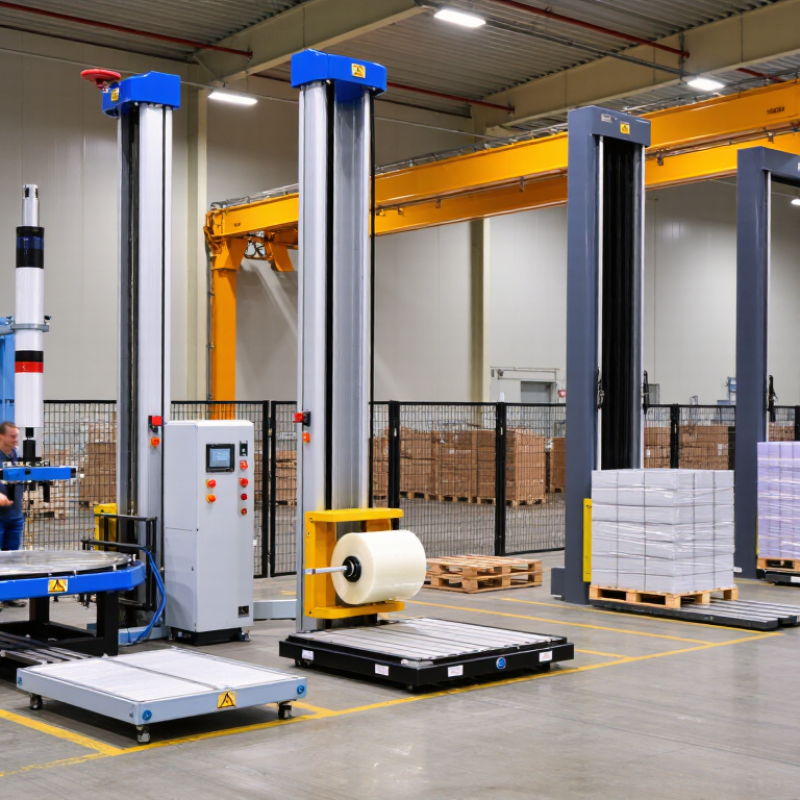
Choosing a pallet wrapper starts with the load, not the brochure. A manual dispenser suits low-volume shipping, while a semi-automatic turntable handles regular loads with less operator effort. Fully automatic turntable wrappers fit steady production lines. Rotary-arm machines keep unstable or heavy pallets still as the film moves around them. Ring wrappers support high-throughput operations. Mobile robotic wrappers travel between loads, useful when fixed equipment is impractical. Inline systems connect wrapping with conveyors and other packaging steps. Fit matters more.

Each design has trade-offs. A mobile unit can serve several stations, but needs clear floor space and consistent setup. A rotary arm can reduce load movement, though it may take more room. MHI’s 2024 Annual Industry Report found that 55% of surveyed supply-chain leaders planned to increase technology investment. That signals broad interest in automation, not a guarantee that a fully automatic wrapper will pay off at every site. Check pallet dimensions, load stability, daily volume, film use, and operator training before choosing. A quick trial with uneven cartons can reveal problems that a neat specification sheet misses.

Go to Top