
Top 10 Types of Conductive Rubber for Buyers?
Conductive Rubber is not one material with one predictable performance curve. Carbon-black compounds, metal-filled elastomers, and conductive silicone can behave very differently under pressure, heat, and repeated flexing. A gasket that works on a clean bench may lose contact after compression cycling. A soft keypad pad may need a different balance of resistance, resilience, and surface feel.
The market context is worth reading carefully. Grand View Research reported that the global conductive polymers market was valued at about USD 5.92 billion in 2023 and projected growth through 2030. That broader category is not a market-size estimate for conductive rubber. It does, however, show rising commercial interest in materials that combine electrical function with polymer processing. Buyers should still verify each supplier’s test conditions, including specimen thickness, applied pressure, temperature, and aging method. Numbers without those details can mislead.
This guide compares ten common types of conductive rubber by composition, electrical behavior, durability, and typical use. It also flags trade-offs that catalogs often compress into a single conductivity figure. One sourcing detail needs caution: no source articles or verifiable expert quotation were supplied, so I will not invent a named expert’s words. That matters. In this field, a confident quote is less useful than a traceable test report and a sample tested in the intended assembly.
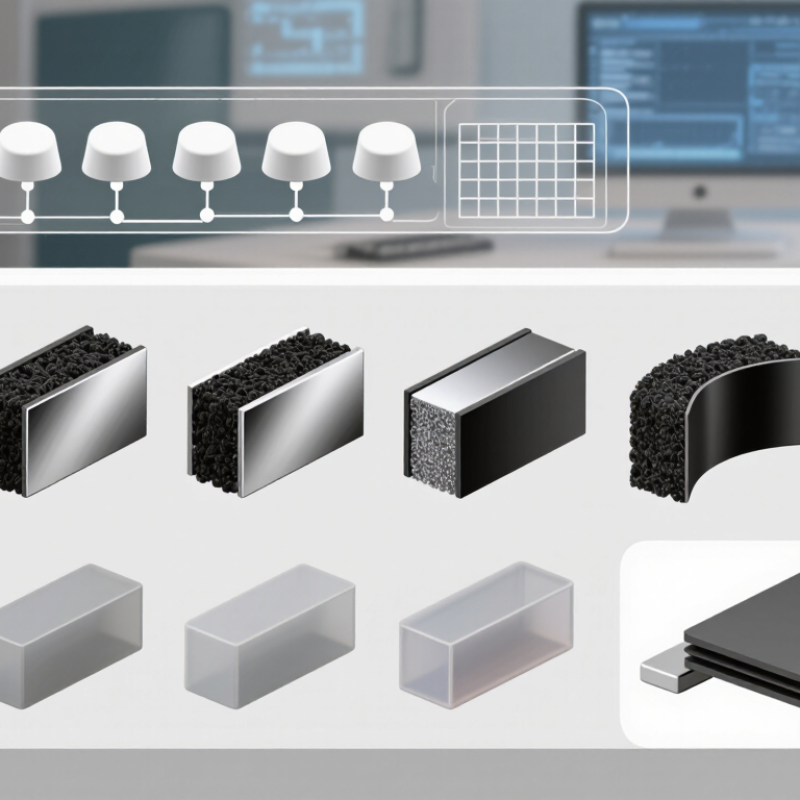
Conductive Rubber Basics: Volume Resistivity and ASTM D257 Measurement
Volume resistivity shows how strongly conductive rubber resists current through its thickness. Lower values generally mean easier current flow. ASTM D257 describes methods for measuring DC resistance and calculating volume resistivity, commonly reported in ohm-centimeters (Ω·cm). Results depend on specimen thickness, electrode geometry, voltage, conditioning, and test duration. Small differences matter. Buyers should compare values only when test conditions match.
One important caveat: ASTM D257 is written mainly for insulating materials. For conductive or antistatic rubber, confirm that the chosen setup suits the expected resistance range; ASTM D991 specifically addresses volume resistivity in conductive and antistatic rubber products. Grand View Research’s 2024 conductive polymers market report estimated that market at USD 5.62 billion in 2023, with projected growth of 8.7% annually from 2024 to 2030. That is a broader category, not a rubber-only figure. Still, it signals growing interest in electrical materials. Request the test method, electrode details, temperature, and actual test results with each specification. A single resistivity number can look precise, yet hide poor comparability. Even careful testing has limits.
Top 10 Types of Conductive Rubber for Buyers: Conductive Rubber Basics, Volume Resistivity and ASTM D257 Measurement
| Conductive Rubber Type | Typical Conductive Phase | Indicative Volume Resistivity Range (Ω·cm) | Common Selection Considerations | Potential Applications |
|---|---|---|---|---|
| Carbon black-filled rubber | Conductive carbon black dispersed in an elastomer | 100–106 | Widely used; performance depends on carbon-black grade, loading, dispersion, and rubber compound. | ESD parts, seals, rollers, gaskets, and antistatic components |
| Graphite-filled rubber | Natural or synthetic graphite particles | 10-1–104 | Can provide electrical conductivity and lubricity; particle alignment and loading affect results. | Conductive seals, contacts, and static-dissipative components |
| Carbon-fiber-filled rubber | Short or milled carbon fibers | 10-2–103 | Fiber orientation and length can make conductivity directional; consider flexibility and surface finish. | Antistatic components, conductive gaskets, and specialty molded parts |
| Carbon-nanotube-filled rubber | Single-wall or multi-wall carbon nanotubes | 10-2–106 | Low filler levels may form conductive networks, but dispersion and processing strongly influence performance. | Flexible sensors, ESD components, and conductive elastomer parts |
| Graphene-filled rubber | Graphene or graphene nanoplatelets | 10-2–105 | Electrical and mechanical properties depend on platelet quality, dispersion, and compound design. | Conductive sheets, flexible components, and research or specialty applications |
| Nickel-coated graphite-filled rubber | Graphite particles with a nickel coating | 10-3–102 | Combines a conductive coating with a graphite core; check corrosion resistance and shielding requirements. | EMI shielding gaskets and conductive seals |
| Silver-coated particle-filled rubber | Silver-coated glass or other particle substrates | 10-4–101 | Can offer high conductivity; evaluate cost, coating integrity, and environmental exposure. | Electrical contacts, EMI shielding, and high-conductivity seals |
| Silver-filled rubber | Silver powder, flakes, or a combination of particle shapes | 10-4–101 | Often selected where low resistance is important; typically has a higher material cost than carbon-filled grades. | Conductive contacts, connector seals, and EMI shielding gaskets |
| Nickel-filled rubber | Nickel powder or flakes | 10-3–102 | Consider particle loading, corrosion environment, flexibility, and the required shielding performance. | EMI shielding seals and conductive enclosures |
| Conductive-polymer-filled rubber | Conductive polymer particles or blends, such as polyaniline or polypyrrole | 100–108 | Properties vary substantially with polymer chemistry, humidity, formulation, and processing. | Static-dissipative parts, flexible electronics, and specialty sensors |
Measurement and buying note: The resistivity bands above are indicative formulation-dependent ranges, not guaranteed specifications; actual values can fall outside them. ASTM D257 covers DC resistance or conductance measurements and calculation of volume resistivity for suitable specimens. Results depend on the test setup and conditions, including electrode configuration, applied voltage, electrification time, specimen thickness, temperature, and humidity. Compare supplier data only when the test method and conditions are comparable, and agree on an acceptance limit for the finished part. Volume resistivity is expressed in Ω·cm; surface resistance is a different measurement and is commonly expressed in ohms or ohms per square.
