
BLOG

What Is the Best Beverage Can End Type in 2026?

In 2026, the best Beverage Can End is not automatically the newest or easiest to open. It is the end that fits the drink, filling line, package design, and customer’s expectations. A crisp snap matters. So does a secure seal. Cost, opening force, material use, and compatibility with existing equipment can change the answer.

Packaging educator Walter Soroka describes packaging as “the science, art, and technology of enclosing or protecting products for distribution, storage, sale, and use.” He was speaking about packaging broadly, not declaring a winning can end. Still, the principle applies: performance depends on the whole package. A standard stay-on-tab end may suit familiar formats, while resealable or larger-opening designs may serve different needs. None is best in every case.

This guide compares the main Beverage Can End options through practical criteria, including consumer experience, production fit, and design trade-offs. It also considers what buyers should verify with suppliers rather than relying on a headline feature. Small details count. A tab that feels smooth in a sample may behave differently on a fast production line. And the “best” choice can be less obvious than expected. That is worth questioning before making a 2026 decision.
What Is the Best Beverage Can End Type in 2026?

What a Beverage Can End Is and How It Works

A beverage can end is the shaped metal lid attached after the can is filled. Its curl meets the body flange in a double seam, where the metal folds together to form a tight closure. The seam must withstand handling and the pressure inside carbonated drinks. At the opening, a scored panel creates a controlled weak line. Lifting the tab uses leverage to rupture that score and expose a drinking aperture. The tab stays attached. A small detail, with a practical purpose.

Most beverage cans use stay-on-tab ends, but the “best” design depends on the can’s contents, opening feel, and production requirements. End dimensions and score depth must match the can and filling process; a poorly matched score can make opening difficult or compromise the seal. Ends are commonly made from stronger aluminum alloy than the can body, helping the tab and scored panel work reliably with thin metal. The Aluminum Association and Can Manufacturers Institute reported a 43% U.S. aluminum beverage-can recycling rate for 2023. That figure describes whole cans, not ends alone, but it underlines why material recovery matters. A can end is small. Its performance is not.

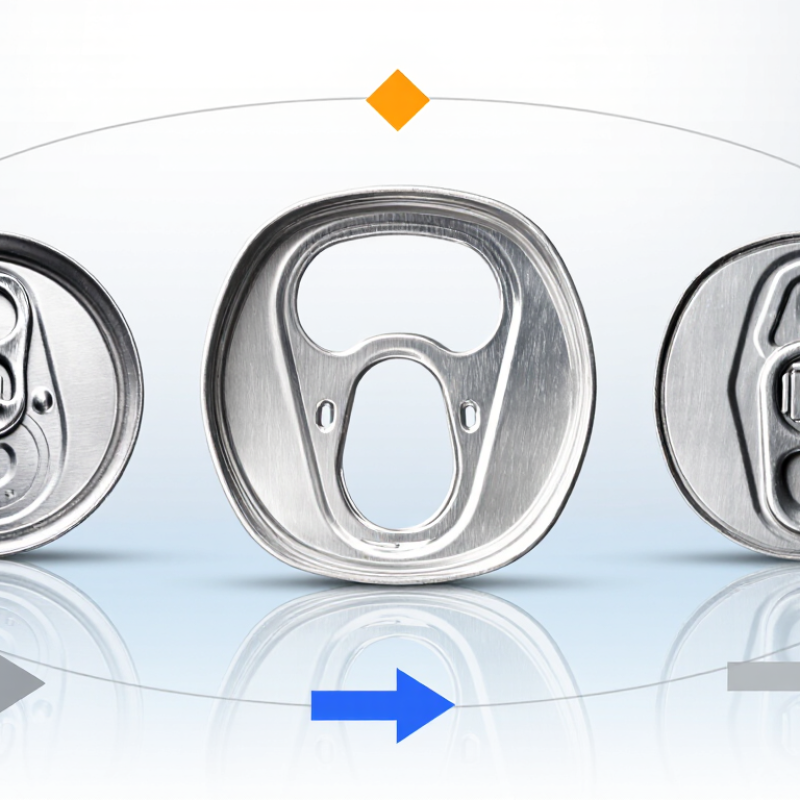
Main Beverage Can End Types Available in 2026

In 2026, the standard stay-on-tab end remains the familiar choice for many carbonated drinks. Its scored panel opens when the attached tab is lifted, while the tab stays connected to the lid. This reduces loose-piece litter and works well on high-speed filling lines. The opening is relatively compact, so drinking feels controlled. A small detail, but noticeable.

Wide-opening ends provide a larger drinking aperture. They can suit beverages intended for quick drinking, and some designs make it easier to add ice after opening. The wider panel also changes the feel of the can and may affect pouring. It is not automatically better; filling equipment, lid strength, and product use all matter. Suppliers may use different names for similar openings, which can make comparisons less tidy than expected.

Full-aperture ends open across most or all of the top panel, creating broad access to the contents. They are useful when a drink is served into a glass or shared, though the exposed opening needs careful handling. Resealable ends are another option, using a sliding or rotating feature to cover the opening again. They add convenience, but also introduce parts and cost. Before choosing an end, packers typically test opening force, leakage, and performance during transport—not just appearance.

Criteria for Comparing Can End Performance

Comparing beverage can ends in 2026 should start with measured performance, not appearance. On a high-speed line, track opening force, tab retention, score integrity, seam leakage, and panel deflection. Test filled cans after vibration, pressure cycling, and temperature changes. Bench tests can miss transit problems. Small differences matter.

Measure opening force across production lots and after aging. Record both low and high readings. Excessive force frustrates consumers; unusually low force may signal a weak score or accidental opening risk. Inspect the opened edge and measure the remaining metal at the score. Test tab attachment and panel strength under pressure, too. Results vary with carbonation, can diameter, material temper, and tooling. One lab result is not a universal winner.

Material use and recovery belong on the comparison sheet, but they do not replace safety checks. The Can Manufacturers Institute reported a 43% U.S. aluminum beverage-can recycling rate for 2022 in its 2023 industry report. That figure describes the overall can stream, not any particular end design. I would compare end weight, production rejects, and opening feedback using the same can body, fill, and line speed. Keep the test conditions consistent. Note where results remain uncertain.

How Can End Designs Affect Safety, Cost, and Sustainability

What Is the Best Beverage Can End Type in 2026?

How Can End Designs Affect Safety, Cost, and Sustainability

A can end is a small part with a demanding job. Its score line must open cleanly, while the panel and seam withstand pressure, handling, and transport. A stay-on tab keeps the lid attached, reducing loose sharp pieces after opening. Small detail. Big consequences. Still, no design is automatically safest: opening force, edge quality, and reliable sealing need testing on the actual production line.

Cost and sustainability depend on the whole package, not just the end. The Can Manufacturers Institute’s 2023 U.S. report estimated a 43% aluminum beverage-can recycling rate and 71% average recycled content. Those figures cover cans overall, not ends alone. Lighter metal may lower material use, but an end that buckles or causes production stoppages can erase savings. Compare metal weight, conversion cost, seam performance, and line speed together. I would not choose by unit price alone.

Tips: Ask suppliers for opening-force and leak-test results, then check performance after cold storage and transport vibration. Confirm that the end matches the can body and filling-line settings. A few real-world trials matter; lab results alone can miss awkward opening or handling issues.

Choosing the Best Can End for Different Beverage Needs

The best beverage can end depends on how the drink is served, stored, and consumed. A standard stay-on-tab end suits many carbonated drinks because it is familiar and keeps the tab attached after opening. For products meant to be poured, a larger opening can improve flow and make the drink easier to share. Match the end to the can body and filling process; pressure and seam requirements should be confirmed with your packaging supplier.

Different drinks call for different trade-offs. A narrow opening may help control sipping, while a wider one can let more aroma reach the drinker. Resealable ends may help when a beverage is consumed over time, but they add parts and can affect cost and line compatibility. They are not automatically the better choice. This detail is easy to overlook.

Tips: Test filled samples under real storage and serving conditions. Check for leaks, opening effort, and how smoothly the drink pours. Ask your supplier to verify seam specifications and equipment fit before a full production run. A small trial can reveal an awkward tab or splash-prone opening. It may not predict every user’s preference, so gather feedback from the people who will actually drink it.

Article Source:

Go to Top